Grace Diviny, Staff Writer
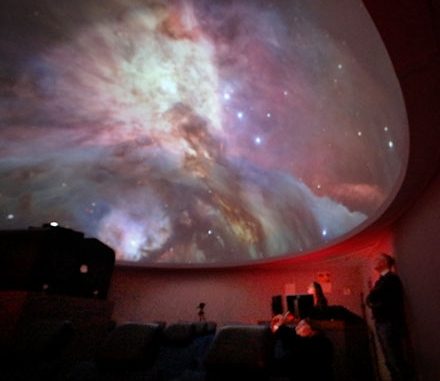
On Saturday, April 4th, families and students gathered for an exhibition at the planetarium in the basement of Perna Science for a showing of ‘The Sky Tonight,’ which depicted our planets and the celestial objects surrounding it at the current moment! Admission is completely free for Oneonta students, and there are two shows on Saturday that you can go to either at 10:30 AM or 11:30 AM.
Before the viewing, the planetarium projector showed a variety of space related questions for people to answer, such as certain planet names or when the first woman went to the moon. It also showed information about schedules for a variety of space shows for those in the audience already interested. Oneonta graduate student Hadley Chan, who was hosting the event, went over safety protocols and basic rules for the show before turning off the lights and illuminating the projector to start the show.
The sky was set around 9:30 PM facing south, where the winter constellation was slowly disappearing because of the Spring equinox in the western hemisphere. We then were introduced to the Orion Nebula, well known for its belt with three stars around it. Surrounding the nebula was Pleiades, famously known for the ‘Seven Sisters’ which formed as a cluster constellation around Taurus.
Around the Orion constellation was the Betelgeuse star, which is a massive red supergiant that is one of the brightest stars in the solar system. Chan also got into the Greek mythologies associated with the constellations, telling us that Orion was the lord of hunting and claimed to be the best hunter, in which he was placed as a constellation by Zeus after his passing. Chan then pointed out the most visible star in our sky, which was Sirius, a constellation that makes out the shape of a dog to represent the “Greater Dog.” Together with Sirius and Betelgeuse is Procyon, which forms the winter triangle seen during the Winter seasons.
According to Chan, there are a total of at least 88 recognized constellations in the night sky. Then, Chan decided to time skip, in which the stars stay the same, but also showed us the Big Dipper in the sky, where we saw a variety of circumpolar stars such as the North Star, also known as Polaris. Chan stated that different cultures see the Big Dipper’s shape differently, and that in Greek mythology, the shape is seen as a bear according to the story of Zeus, in which he sent his friend Callisto and her son Acras into the sky as the bears to protect them from being hunted down from his enemies.
However, due to the changing seasons, certain stars such as Betelgeuse and Sirius can only be seen in the sky during the wintertime, in which the springtime brings way to stars such as Arcturus, Spica, and Regulus, the last two consist of zodiac signs Virgo and Leo. One of these prominent stars is the Corona-Borealis, in which Chan said that scientists are expecting it to explode in the next few months that would be visible to the naked eye. Next to the Corona-Borealis is Heracles, who in Greek mythology was known for his strength and being the son of Zeus. Chan then took this opportunity to zoom out of Earth and visit a few different planets orbiting the sky at the current moment, in which they zoomed onto Jupiter, the largest planet in the sky with the fastest rotation in the sky according to them. They also pointed out Jupiter’s big red spot, along with the planet’s estimated 95 moons. Other planets, such as Saturn and Neptune, were also shown, with Saturn having the most moons at 274 and Neptune taking at least 164 years to complete a rotation. The show concluded with Chen touching up on Mars, in which they mentioned the Artemis II launch in the process when discussing proof of water and sustainable living on Mars.
If you are a space enthusiast, or are looking for something to destress before finals week, absolutely come by and see this amazing show!
Leave a Reply